Tips to qualify for the EB-5 Investment Amount and secure your U.S. Visa
EB-5 Visa Explained: Exactly How to Obtain a Visa Through Investment
The EB-5 Visa program provides a distinct possibility for international financiers seeking U.S. permanent residency with an organized investment approach. With specific qualification criteria and financial investment limits, the procedure requires cautious consideration and calculated planning. Recognizing the nuances of the application procedure, consisting of the differences in between local facilities and direct financial investments, is crucial for prospective applicants. As this path unfolds, possible investors should navigate numerous benefits and obstacles that accompany it. What are the vital factors that can influence the success of an EB-5 application?
Introduction of EB-5 Visa
The EB-5 Visa program, made to promote the united state economic situation through international investment, offers a path to irreversible residency for qualified capitalists and their households. Developed by the Immigration Act of 1990, the program intends to bring in foreign funding to produce tasks and enhance economic development in the USA. Financiers that add a minimal total up to an approved task can get this visa, thus enabling them to spend in numerous industries, including realty, framework, and various other companies.
The EB-5 program is especially appealing as a result of its twin benefits: a chance for economic returns on financial investments and the potential for U.S. citizenship. By investing in targeted employment areas (TEAs), which are specified as rural regions or locations with high unemployment, investors might receive a lowered investment limit. The program needs the development of at the very least ten permanent work for united state employees as a direct outcome of the investment. Effective applicants receive a conditional visa for two years, after which they can make an application for irreversible residency, given they fulfill all program requirements. This pathway has gathered interest from capitalists around the world, making it a crucial element of united state migration plan.
Qualification Standards
To receive the EB-5 Visa, investors must satisfy certain eligibility requirements that ensure their investment adds to job creation and financial development in the USA - EB-5 Investment Amount. Candidates need to invest a minimum of $1 million in a brand-new industrial venture, or $500,000 if the investment is made in a targeted employment location (TEA), which is normally characterized by high unemployment or country locations.
Additionally, the venture needs to preserve or produce at the very least ten permanent jobs for certifying U.S. employees within two years of the investor's admission to the United States. Capitalists are also called for to demonstrate that their mutual fund were gotten through authorized ways, offering proof such as tax returns and financial institution declarations.
An additional critical requirement is that the investment must remain in a for-profit service entity that was established after November 29, 1990, or one that has actually been restructured or increased to satisfy the EB-5 needs. Ultimately, applicants need to demonstrate their intent to proactively join the company, ensuring that their participation adds to its success. Fulfilling these eligibility needs is essential for investors seeking to obtain long-term residency via the EB-5 program.
Investment Options
When taking into consideration the EB-5 visa, investors should evaluate their alternatives between straight financial investment possibilities and regional center programs. Each option brings details job development demands that are vital for satisfying the visa standards. Recognizing these investment methods is crucial for making an educated decision that lines up with both monetary objectives and migration purposes.
Direct Investment Opportunities
Direct investment chances under the EB-5 Visa program offer foreign financiers with a pathway to obtain united state irreversible residency while adding to the American economic situation. Unlike regional center investments, straight investments require capitalists to proactively handle their service ventures within the united state, enabling prospective greater control and impact over their investment outcomes.
To get the EB-5 Visa via direct financial investment, foreign nationals have to invest a minimum of $1 million in a brand-new company or $500,000 in a targeted employment location, which is defined as a country area or an area with high joblessness. The financial investment has to result in the creation of at the very least ten full-time work for qualifying united state employees within two years.
Straight investment choices can differ commonly, incorporating industries such as actual estate development, production, friendliness, and innovation start-ups. Financiers should carry out extensive due diligence to analyze the practicality of their picked service version and guarantee compliance with EB-5 policies. Engaging with economic and legal experts experienced in EB-5 issues is a good idea to browse the intricacies of direct financial investment opportunities and make the most of the capacity for an effective application.
Regional Facility Programs
Leveraging the EB-5 Visa program, regional facility programs use a streamlined financial investment avenue for foreign nationals seeking U.S. permanent residency. These programs are designated by the U.S. Citizenship and Immigration Provider (USCIS) and focus on merging financial investments to money different financial advancement projects, which may include real estate, infrastructure, and company enterprises.
Investors generally contribute a minimum of $900,000 in targeted employment locations or $1.8 million in various other regions. EB-5. One of the major advantages of regional center programs is that they permit investors to fulfill the EB-5 financial investment requirements through indirect work development, rather than guide job development called for in straight investment chances
Regional centers take care of the financial investment in support of the financiers, using a more easy technique than straight investment. This administration consists of managing task growth, financial reporting, and compliance with USCIS guidelines. Additionally, regional facilities commonly have established performance history, enhancing the self-confidence of prospective financiers.
Inevitably, local facility programs present a compelling option for those looking to browse the complexities of the EB-5 Visa procedure while adding to U.S. financial growth and work creation.
Job Creation Needs
To certify for an EB-5 Visa, capitalists have to confirm that their resources financial investment leads to the production of at least ten full time work for U.S. employees within 2 years. This work production requirement is an important part of the EB-5 program, made to promote the U.S. economic situation and advertise economic growth.
Investors can pick between two key investment options: direct investments and financial investments through Regional Centers. With direct investments, the capitalist needs to actively take care of the organization and assurance job development, while likewise showing that the tasks produced are for united state residents or authorized irreversible citizens. On The Other Hand, Regional Facility investments permit financiers to pool their resources right into an assigned project, typically resulting in indirect job production, which can be counted towards satisfying the task need.
To efficiently fulfill the work creation requirements, it is essential for capitalists to function carefully with seasoned specialists who can lead them with the complexities of the EB-5 program. Appropriate preparation and adherence to regulations are crucial to confirm compliance and safeguard a path to irreversible residency. Failing to satisfy these work production requirements can threaten the investor's EB-5 application and their migration condition.
The Application Process
The application procedure for the EB-5 visa entails a series of crucial steps and details qualification requirements that applicants should meet. Comprehending these criteria is important for an effective application. This area will outline the required qualifications and provide a detailed guide to steering with the process.

Qualification Requirements Review
Recognizing the eligibility requirements for the EB-5 visa is vital for prospective capitalists seeking to get irreversible residency in the United States. To certify, a private must demonstrate a minimum investment of $1 million in a new business, or $500,000 if the investment is made in a Targeted Employment Location (TEA), which is specified as a rural location or one with high joblessness.
Furthermore, the financier needs to reveal that the financial investment will develop or maintain at the very least ten full-time jobs for U.S. workers within two years of the financial investment. The enterprise has to additionally be a for-profit entity and has to be freshly established or considerably remodeled if it is an existing service.
The applicant must prove that the financial investment funds are acquired through legal means, consisting of personal cost savings, gifts, or car loans supported by correct documents. In addition, the investor must actively take part in business, guaranteeing their engagement in the monitoring of the business. Meeting these qualification requirements is essential for an effective EB-5 application and inevitably securing a copyright via this investment method.
Step-by-Step Procedure
Once eligibility demands are fulfilled, possible financiers can start the application process for the EB-5 visa. The initial step includes finishing Kind I-526, the Immigrant Application by Alien Financier. This form needs to be come with by sustaining documentation that shows the investor's certifying investment and the creation of at least ten permanent jobs for U.S. employees.
Upon approval of Type I-526 by the USA Citizenship and Immigration Solutions (USCIS), capitalists can get the EB-5 visa with either consular handling or modification of status, depending upon their existing residency. For those outside the united state, this means sending a visa at a united state consulate. On the other hand, if currently in the U.S., applicants have to file Type I-485, Application to Register Permanent Home or Readjust Standing.
After approval, investors and their eligible relative get conditional permanent residency for two years. Within 90 days before the expiry of this conditional status, capitalists should submit Kind I-829, Application by Entrepreneur to Remove Problems, to acquire irreversible residency. Effective completion of this step wraps up the EB-5 investment process, giving the capitalist a Visa.
Regional Centers vs. Straight Investments
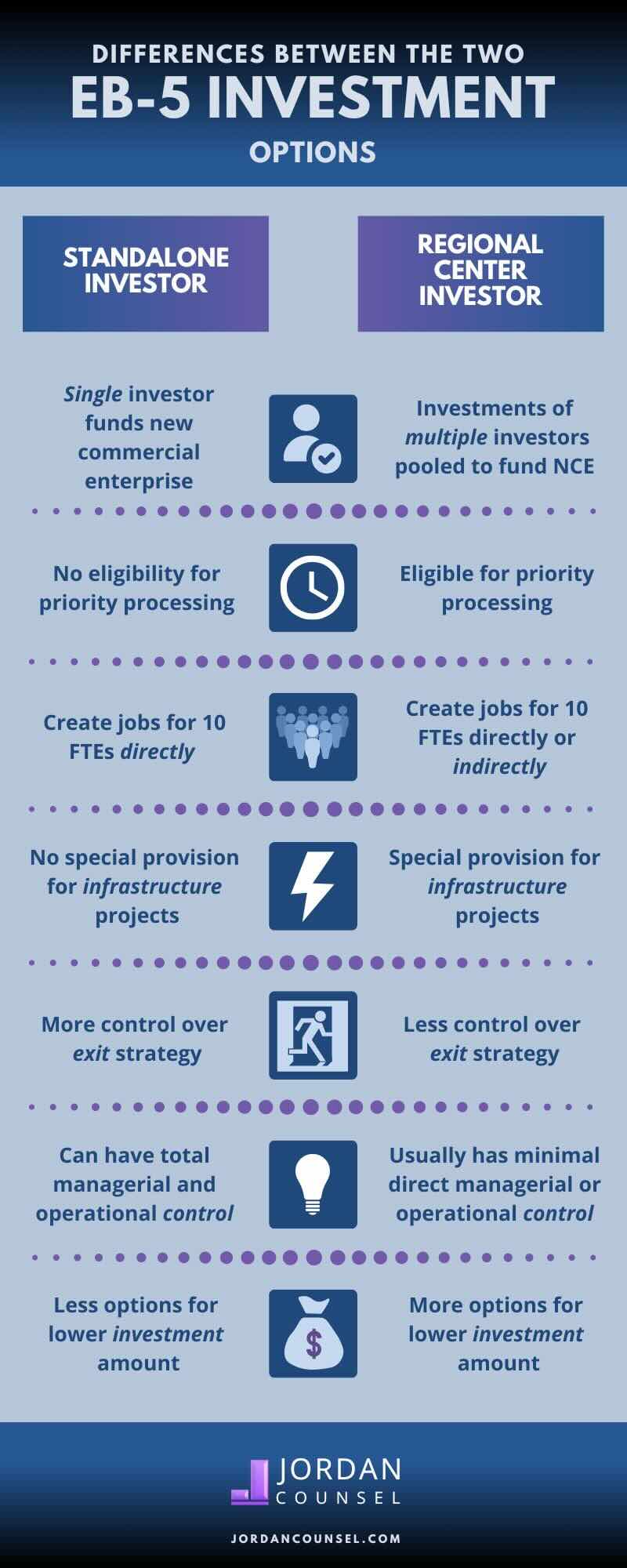
Steering the EB-5 visa program involves an important decision in between straight financial investments and regional facilities, each offering unique paths to acquiring irreversible residency in the USA - Targeted Employment Area TEA. Regional facilities are assigned by the USA Citizenship and Immigration Solutions (USCIS) to advertise economic development through job production. When spending through a regional facility, capitalists generally add to a pooled fund, which is managed by the. This option often enables a more passive financial investment technique, as the center oversees the task and work creation requirements
In contrast, straight financial investments call for investors to actively manage their own service ventures in the United States. This method demands an extra hands-on involvement, as the financier click here now must create and maintain at least ten full time work straight pertaining to their business. While direct financial investments may use higher control over the financial investment outcome, they additionally require greater threats and obligations.
Ultimately, the option between straight financial investments and local facilities rests on private risk resistance, wanted involvement level, and financial investment goals. Understanding these distinctions is crucial for investors seeking to browse the complexities of the EB-5 visa program effectively.
Advantages of the EB-5 Visa
The EB-5 visa program supplies many benefits for international investors looking for long-term residency in the USA. One of the most substantial advantages is the chance for investors and their prompt household members, consisting of partners and youngsters under 21, to obtain a permit, granting them the right to live and function in the united state forever.
The EB-5 program does not call for an enroller, allowing investors greater freedom in their immigration journey. This program additionally offers a pathway to citizenship after 5 years of permanent residency, promoting long-term security for families. In addition, investing with assigned Regional Centers can be less troublesome, as these entities frequently handle the task and task production requirements in support of the investor.
Moreover, the EB-5 visa can lead to substantial monetary returns, as financial investments are typically directed toward companies that can pay. By adding to financial development and work production in the United state, EB-5 investors play an essential function in improving neighborhood areas. Overall, the EB-5 visa acts as an engaging option for those looking to protect a future in the United States while making a positive influence.
Common Challenges and Factors To Consider
While the EB-5 visa program offers appealing benefits for international investors, it likewise includes its share of difficulties and considerations that potential candidates need to very carefully review. One considerable difficulty is the monetary commitment included, as the minimum investment quantity is significant, normally established at $1 million or $500,000 in targeted work locations. Capitalists need to assure that they have adequate funding and a clear understanding of the associated risks.
Moreover, prospective capitalists need to carry out thorough due diligence on the financial investment tasks to stay clear of deceitful systems. The success of an EB-5 application depends upon the creation of a minimum of ten full-time tasks for united state employees, requiring mindful planning and monitoring of the company's efficiency (EB-5 Investment Amount). Eventually, navigating these difficulties requires a tactical approach and usually the support of knowledgeable experts in migration and investment legislation
Frequently Asked Questions
The length of time Does the EB-5 Visa Process Usually Take?

Can Household Members Apply With the Main EB-5 Applicant?
Yes, member of the family can use alongside the primary applicant. EB-5 Visa by Investment. Qualified dependents usually consist of spouses and single children under 21, enabling them to acquire permits contingent upon the key candidate's effective visa authorization
What Takes place if My Financial Investment Stops working?
It may jeopardize your migration standing and the possibility for acquiring an environment-friendly card if your financial investment falls short. It's essential to carry out detailed due persistance and think about risk reduction techniques before waging any kind of investment.
Exist Age Restrictions for EB-5 Investors?
There are no certain age restrictions for EB-5 investors; nevertheless, the private must go to the very least 18 years of ages to legitimately participate in financial investment agreements. Minors might certify through adult investment and sponsorship.
Can I Traveling Outside the U.S. Throughout the Application Process?
Taking a trip outside the united state throughout the application procedure might impact your standing. It is suggested to speak with a migration lawyer to comprehend potential risks and assurance conformity with all requirements while your application is pending.
Regional centers manage the financial investment on part of the investors, supplying a much more easy approach than straight financial investment. To qualify for an EB-5 Visa, financiers must verify that their funding financial investment results in the development of at the very least ten permanent jobs for U.S. employees within two years. Capitalists can select in between 2 key investment alternatives: direct investments and financial investments with Regional Centers. The capitalist must show that the financial investment will certainly maintain or develop at the very least 10 full-time tasks for U.S. workers within 2 years of the financial investment. Ultimately, the option in between direct investments and regional facilities hinges on private danger resistance, wanted participation degree, and financial investment objectives.